Admission Enquiry 
Admission Enquiry

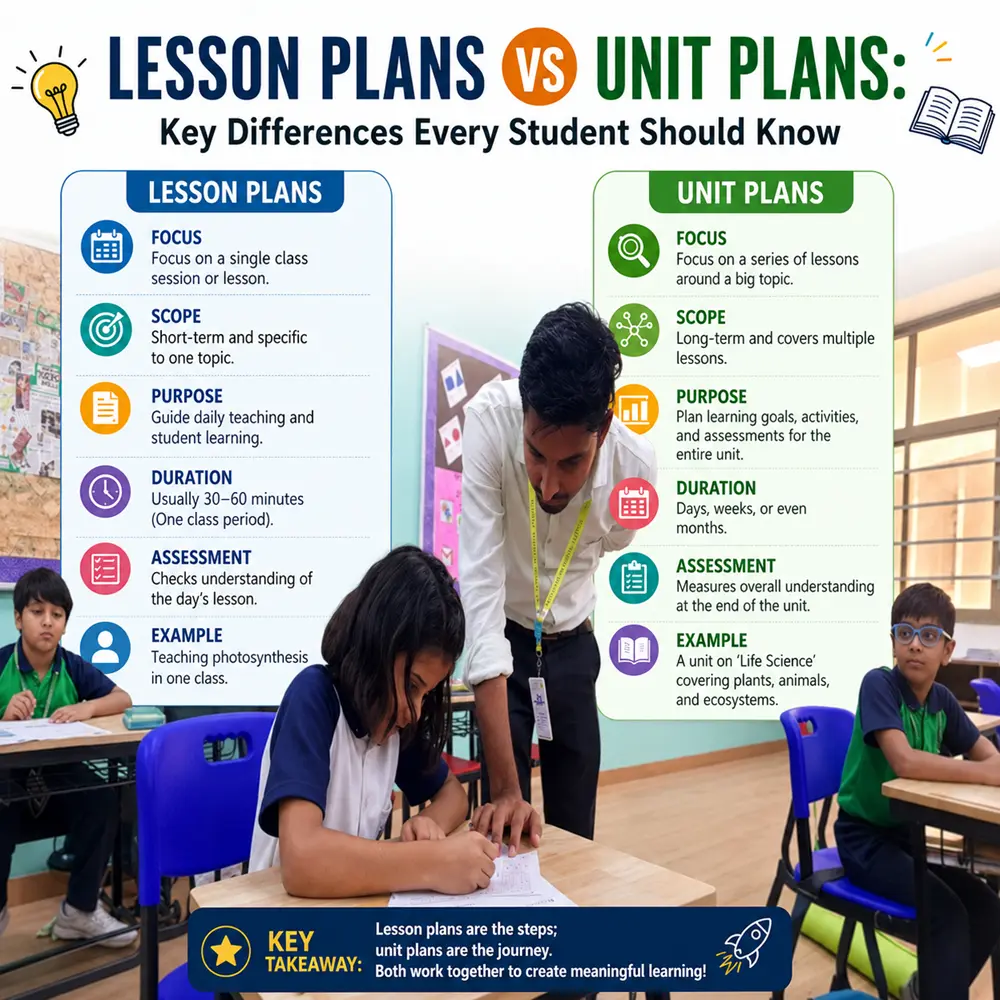
If you've ever wondered why your teacher hands out a "weekly schedule" some days and a "topic overview" on others, you've already brushed against the difference between lesson plan and unit plan. Understanding this difference isn't just useful for teachers; it helps students and parents make smarter choices about schools, whether you're comparing CBSE vs ICSE vs IB boards or figuring out how your child's school organises its academic year. Let's break it all down in plain, simple language.
A lesson plan is a teacher's detailed guide for a single class session, typically 30 to 60 minutes long. Think of it as a recipe for one meal. It answers very specific questions:
A lesson plan is highly focused. It outlines the learning objective for the day, the teaching method (lecture, discussion, activity), the materials needed, and the assessment, all within the frame of one class period.
For example, if a Grade 5 science class is studying "The Water Cycle," a single lesson plan might only cover evaporation, one small piece of the larger puzzle.
A unit plan (also called a unit of work or curriculum unit) is a broader, long-term teaching framework that covers an entire topic or theme, usually spanning 2 to 6 weeks. If a lesson plan is one meal, a unit plan is the full week's menu.
It maps out all the lessons that will be taught under one big topic and shows how they connect. For the Grade 5 science example, a unit plan on "The Water Cycle" would cover:
Here's where most students and parents get confused. Let's put the difference between unit planning and lesson planning side by side so it's crystal clear.
|
Feature |
Lesson Plan |
Unit Plan |
|
Duration |
1 class (30–60 mins) |
2–6 weeks |
|
Scope |
One topic/concept |
Complete chapter or theme |
|
Objectives |
1–2 specific outcomes |
Multiple broad outcomes |
|
Detail Level |
Very detailed, minute-by-minute |
High-level overview |
|
Assessment |
Quick checks (quizzes, Q&A) |
Major tests, projects, and presentations |
|
Flexibility |
Low structured for the day |
Highly adjustable week to week |
|
Who Uses It |
Teacher (daily) |
Teacher + HOD + curriculum planner |
|
Relationship |
Part of a unit plan |
Contains multiple lesson plans |
The Simplest Way to Remember It:
Unit Plan = The Big Picture. Lesson Plan = The Daily Details.
You might think, "This is a teacher thing, why should I care?" Actually, understanding this structure helps you in real, practical ways:
When you know your teacher is following a unit plan, you can predict what's coming next and prepare in advance instead of cramming the night before a test.
If you know today's lesson on "Photosynthesis" is part of a 3-week unit on "Plant Biology," you understand why concepts are being taught in a specific order.
Unit plans often reveal when the big tests or projects are due. Ask your teacher about the unit plan at the start of every term. It's completely okay to do so.
If you missed a few classes, knowing the unit structure helps you identify exactly which lessons you need to catch up on.
Most experienced educators, especially in IB and CBSE schools, use a method called backward design to develop unit plans. This means:
This ensures every lesson plan has purpose and connects meaningfully to the bigger learning goal.
Today, many schools, including those with transparent best school in Jaipur with fee structure details, use digital tools to create and share these plans with parents. Some even use free AI tools for students and teachers to auto-generate lesson frameworks, saving planning time while maintaining quality.
Follow a term-wise syllabus divided into units. Teachers create lesson plans within each prescribed unit, with little room to deviate from the official curriculum structure.
Allow slightly more flexibility in how units are broken down, giving teachers room to add their own lesson-plan creativity.
Use the "Units of Inquiry" framework, one of the most sophisticated unit planning systems in the world. Every unit has a central idea, and all lessons connect to it. If you're studying at an IB school in Rajasthan, your teachers are creating extremely detailed unit plans with interdisciplinary connections.
Schools that cater to CBSE school in Jaipur for Special Education Needs often adapt both lesson and unit plans with differentiated learning paths, ensuring every child progresses meaningfully through the curriculum.
Even at the preschool level, this planning structure exists, though in a gentler, play-based form. A best preschool program doesn't just "freestyle" activities every day. Teachers plan thematic units (like "Animals," "Seasons," or "Family") and design daily play-based lessons that build toward those themes.
This early planning foundation is what helps children develop life skills vs moral values alongside academic content because thoughtful planning leaves room for both.
If you're a parent evaluating schools, say you're looking at the best CBSE school in Jaipur or thebest English medium school in Jaipur, here are smart questions to ask:
A school that plans thoughtfully and transparently at both the unit and lesson level is usually a school that delivers consistent, quality education.
A unit plan is a long-term framework covering an entire topic over multiple weeks, outlining all lessons, objectives, and assessments. A lesson plan is a short-term, detailed guide for a single class session within that unit. Together, they form the backbone of quality teaching. One provides the direction, the other provides the daily roadmap.
Students preparing for upcoming exams or recovering from setbacks can also read about the CBSE Compartment Exam 2026 to understand how structured planning can help them bounce back and succeed.
Whether you're a student trying to understand how your school works, a parent choosing between schools, or simply curious about what happens behind that classroom door, knowing the difference between a lesson plan and a unit plan gives you a real edge. Smart planning leads to smart learning. The next time you sit down in a classroom, remember: behind every great lesson is a great unit plan, making sure everything adds up to something meaningful.
If you're in the process of selecting the right school for your child, exploring the best English medium school in Jaipur options with a lens on curriculum planning quality will help you make a more informed, confident decision.
A lesson plan covers one class period with one specific objective, while a unit plan covers an entire topic over multiple weeks with several learning goals. A unit plan contains many lesson plans within it.
Always the unit plan. Teachers design the overall unit first (deciding what students need to learn and how they'll be assessed), and then create individual lesson plans that fit within that unit structure.
Technically, yes, but it's not ideal. Without a unit plan, individual lessons can feel disconnected and random. Good teaching requires both the big picture (unit) and the daily detail (lesson).
Most unit plans span 2 to 6 weeks, depending on the subject, grade level, and school board. Some complex units in higher grades can run for an entire term (10–12 weeks).
No. The format varies by school board (CBSE, ICSE, IB, State Boards) and individual school policy. IB schools follow a highly structured 'Units of Inquiry' framework, while CBSE schools follow term-wise unit divisions set by the board.
Yes, and most good schools encourage this. Knowing what's coming helps students prepare, manage time, and reduce exam anxiety. Don't hesitate to ask your teacher for an overview at the start of each new unit.
Good unit and lesson plans include differentiated learning strategies, meaning the same content is taught in multiple ways to suit different learning styles and abilities. Schools focused on inclusive education adapt both plans to ensure every student can access and achieve the learning goals.

Copyright ©2026 held by Global Institute of Technology Society and Mayoor School Jaipur | This template is made with by Shopivana
