Admission Enquiry 
Admission Enquiry

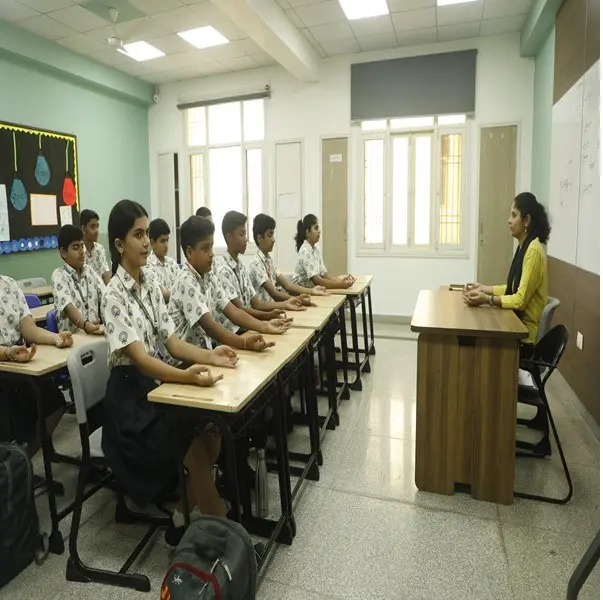
When parents search for the best school in Jaipur, they often focus on academics, fee structures, and board affiliations. But the most thoughtful parents ask a deeper question: Will this school help my child grow as a person? Personality development is not a subject taught from a textbook; it is something that happens every day, in every classroom, on every playground, and through every interaction a child has within a school environment.
Personality development refers to the gradual process by which a child builds their identity, values, emotional intelligence, communication skills, self-confidence, and social awareness. It is the complete shaping of who a child becomes, not just what they know, but how they think, feel, and behave in the real world.
Schools serve as the first and most consistent external environment where this development unfolds. From the age of 3 or 4 in preschool programs to the final years of senior secondary education, children spend thousands of hours in school settings that either nurture or neglect their holistic growth.
One of the most powerful contributions of a good school is helping children discover what they are capable of. When a shy child performs in a school play, when a student solves a difficult math problem, or when a young athlete wins a relay race, these moments build genuine self-esteem.
Confidence is not handed to children; it is built through small, repeated experiences of trying, failing, learning, and succeeding. Schools that celebrate effort, not just results, create an environment where children are not afraid to take risks or speak their minds.
Personality development thrives in social settings. Schools bring children together from diverse backgrounds, encouraging them to communicate, collaborate, and sometimes disagree, all essential real-world skills.
Group projects, debates, morning assemblies, class discussions, and even lunch breaks teach children how to express themselves clearly, listen actively, and resolve conflicts gracefully. These are skills that no amount of home tutoring can fully replicate.
Schools are not just about subjects; they are about values. A child who learns to be honest during an exam, respectful to teachers, kind to a classmate who is struggling, or responsible about completing commitments is learning something far more valuable than trigonometry.
Value-based education, moral science classes, community service programs, and even school traditions all contribute to character building. These become the invisible foundation of a child's adult personality.
The importance of personality development in education is perhaps most visible in how schools shape the way children think. A school that encourages questions, even uncomfortable ones, produces children who are curious, analytical, and independent in their thinking.
Science experiments, debates, project-based learning, and creative writing assignments all push children to think beyond textbook answers. Critical thinkers make better decisions, adapt more easily to change, and show more emotional resilience in difficult situations.
Emotional intelligence, the ability to understand and manage one's own emotions while recognising the feelings of others, is one of the most important dimensions of personality development. Schools play a powerful role here through counselling support, peer mentoring programmes, and teacher-student relationships built on trust.
School support programs such as mental health workshops, buddy systems, and student wellness initiatives are increasingly being adopted by forward-thinking schools. These programmes help children identify their emotions, express them healthily, and build genuine empathy for those around them.
Every child has leadership potential waiting to be unlocked. Schools provide the perfect setting through student councils, sports captaincies, cultural committees, science club presidencies, and classroom monitor roles. These experiences teach children to take responsibility, delegate tasks, inspire peers, and handle pressure.
Equally important is learning to be a good team member to support, follow when needed, and contribute without ego. Both leadership and teamwork are personality skills that shape professional and personal success throughout life.
A school routine, waking up on time, completing homework, meeting deadlines, attending classes, and carrying out duties teaches children discipline and time management in the most organic way possible. These habits, when formed early, become core traits of a well-developed personality.
Children who are taught to be responsible for their actions and accountable to their peers and teachers grow into adults who are reliable, organised, and trustworthy.
Personality is not one-dimensional, and neither should a child's school life be. Music, dance, drama, robotics, debate, sports, and painting extracurricular activities allow children to discover passions that academic subjects may never reveal.
A child who struggles in the classroom but excels on the football field develops self-worth, identity, and resilience that carry into every other area of life. Schools that offer rich extracurricular environments are investing directly in the personality development of each student.
The digital age has added a new dimension to personality development. 5 educational apps for kids, from coding platforms to language learning tools, are now being integrated into modern school curricula to develop problem-solving skills, digital literacy, and creative thinking.
Schools that blend traditional teaching with thoughtfully curated technology help children become adaptable, tech-confident individuals ready for a rapidly changing world.
For families considering school admissions, understanding the educational framework matters greatly. The benefits of CBSE education for your child extend well beyond academic preparation. The CBSE curriculum is designed with holistic development in mind, incorporating life skills education, health and physical education, art integration, and project-based learning into its structure.
The CBSE school admission process typically opens early in the calendar year, and parents exploring the right choice for CBSE admissions 2026–27 should look not just at academic rankings but at a school's track record in producing well-rounded, confident, and emotionally mature students.
For parents in Rajasthan looking at the best school in Jaipur with a fee structure, it is worth evaluating whether the fee investment reflects access to counsellors, extracurricular facilities, modern libraries, digital learning tools, and trained teachers, all of which directly impact personality development.
Schools do most of the heavy lifting, but parents play an irreplaceable role. Encouraging open conversations at home, praising effort over grades, exposing children to different experiences, and modelling healthy emotional behaviour all reinforce what great schools are already building.
The parent-school partnership is perhaps the most underrated factor in personality development.
Personality development is not an add-on to education; it is the very heart of it. A child who leaves school with top marks but poor communication skills, low self-esteem, or no sense of values has not received a complete education. The best schools understand this deeply and design every aspect of school life from the classroom to the corridor, from the curriculum to the culture, to help children grow into confident, compassionate, and capable human beings.
As you evaluate schools for your child, whether exploring preschool programs for your little one or making a serious decision about secondary admissions, ask yourself: Does this school develop personalities, not just performances? That answer will guide you to the right choice.
Personality development in children refers to the gradual process of building self-confidence, communication skills, emotional intelligence, values, and social behaviour. It shapes who a child becomes as a person, beyond academic achievement.
Schools contribute through structured learning, extracurricular activities, value education, social interaction, leadership opportunities, and emotional support programmes, all of which shape a child's character and identity over time.
Personality development begins as early as infancy, but the school years, starting from preschool, are among the most formative periods. Experiences between the ages of 3 and 18 have a lasting impact on personality traits.
Extracurricular activities help children discover hidden talents, build confidence, learn teamwork, develop discipline, and express themselves creatively, all of which are vital components of a well-rounded personality.
CBSE schools incorporate life skills, art integration, physical education, and project-based learning precisely because the importance of personality development is acknowledged at a national curriculum level. The aim is to produce not just exam-ready students but life-ready individuals.
Parents can support personality development by encouraging open communication, praising effort, exposing children to diverse experiences, reading together, and modelling emotional intelligence and respectful behaviour at home.
Look for schools with experienced counsellors, active extracurricular programmes, a positive and inclusive school culture, trained and empathetic teachers, and a curriculum that values character building alongside academics, not just academic rankings or fee structures.
Copyright ©2026 held by Global Institute of Technology Society and Mayoor School Jaipur | This template is made with by Shopivana
