Admission Enquiry 
Admission Enquiry
Every parent wants their child to be ready for the future. But here's the reality: the future is arriving faster than we imagined. Careers that didn't exist a decade ago are now mainstream, and tomorrow's job market will look even more different. That's precisely why schools across India and around the world are shifting toward STEAM education, a learning approach designed not just to fill children with information, but to build thinkers, creators, and confident problem-solvers. If you're wondering whether your child's school is truly future-ready, understanding STEAM is the first step. And if you're searching for a school in Jaipur that genuinely practises this approach, keep reading.
STEAM education stands for Science, Technology, Engineering, Arts, and Mathematics. But it is far more than an acronym. At its heart, STEAM is a teaching philosophy that integrates these five disciplines into a connected learning experience rather than treating each subject as a separate, unrelated unit.
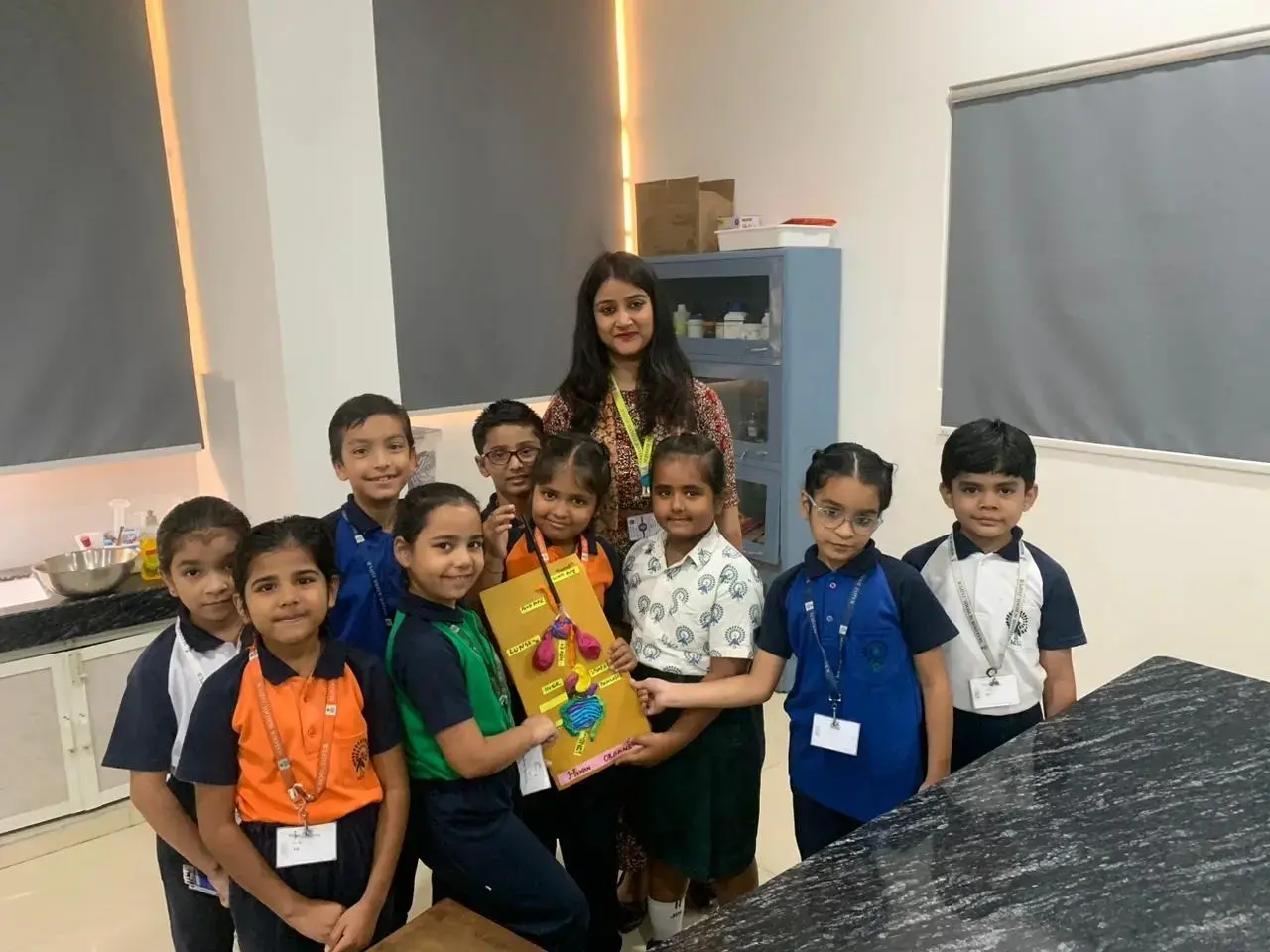
Think of it this way: when a child builds a bridge using craft materials, they are applying engineering principles, understanding basic physics, calculating measurements (mathematics), and designing something with intention (arts). That single activity is STEAM in action, and it's exactly how learning should feel.
What is STEAM education, and why is it important? Because in the real world, no challenge is purely mathematical or purely artistic. Every complex problem requires a blend of skills, and STEAM is designed to build that blend from an early age.
You may have heard of STEM: Science, Technology, Engineering, and Mathematics. STEAM simply adds the 'A' for Arts. But that one letter changes everything.
Including Arts, which covers design thinking, storytelling, visual expression, and creativity, helps students move beyond technical correctness toward truly human-centred innovation. A programmer who understands design builds better products. An engineer who thinks creatively solves problems more elegantly. The Arts element teaches students how to communicate, collaborate, and connect emotionally with the people they are trying to help.
In short, STEM tells you how things work. STEAM teaches you how to use that knowledge beautifully and meaningfully.
We are living through one of the most rapid periods of change in human history. Artificial intelligence, automation, climate challenges, and digital transformation are reshaping every industry. Estimates suggest that many of today's primary school students will work in roles that do not yet exist.
So, what is STEAM education and why is it important in this context? Because it prepares students for uncertainty. It doesn't just teach children what to think, it teaches them how to think. The skills developed through STEAM critical reasoning, creativity, adaptability, collaboration, and digital fluency are precisely what future employers and entrepreneurs will value most.
Here is what STEAM education builds in every student:
These are not just academic abilities. They are practical life skills that will serve children across every career path, every relationship, and every challenge they encounter throughout their lives.
One of the most common questions parents ask is: How does STEAM education actually work day to day? The answer varies by school, but in a genuinely STEAM-integrated environment, learning happens through exploration, making, and reflection rather than memorization and repetition.
Here are some real-world examples of STEAM activities:
Each of these requires students to draw from multiple disciplines simultaneously, which is exactly how the real world operates. Thoughtful STEAM schools also think carefully about how learning is structured at different levels. Understanding the
difference between lesson plan and unit plan is one of the ways skilled educators design STEAM experiences that build progressively over time, rather than treating each class as a standalone event.
Parents often debate school board options. Understanding the CBSE vs ICSE vs IB Board distinctions matters, and STEAM education can be delivered within all three frameworks, though with different levels of flexibility and emphasis.
CBSE has progressively updated its curriculum framework to emphasize competency-based learning, which aligns naturally with STEAM thinking. IB schools have long championed inquiry-led approaches. ICSE balances academic breadth with depth. What ultimately matters is not the board alone, but whether the school actively builds STEAM thinking into its daily culture.
At Mayoor School Jaipur, we follow the CBSE curriculum while embedding STEAM principles across every aspect of school life from labs and workshops to co-curricular activities and student exhibitions.
Technology is not simply one subject within STEAM; it is a tool and a medium through which all learning is amplified. Today's students are digital natives, and giving them meaningful, guided access to technology transforms how they learn and create. Schools are now helping students use free AI tools for students to explore concepts, build projects, and solve problems in ways that were barely imaginable a few years ago.
From 3D modelling software and robotics kits to coding platforms and augmented reality experiences, STEAM classrooms buzz with experimentation. Students are not simply consumers of technology; they become creators through it. This develops digital literacy early, ensuring children are equipped for a world where technological fluency is as fundamental as reading and writing.
Here's something that often goes unmentioned: STEAM education doesn't just improve academic outcomes; it genuinely benefits children's mental and emotional health.
When students engage in meaningful, hands-on work, they feel motivated, valued, and capable. The experience of actually making something, or watching their ideas become reality, is a powerful counterbalance to academic anxiety. Parents who want to reduce exam stress in children will find that a STEAM-oriented approach shifts the focus from marks to mastery, a healthier, more sustainable foundation for learning.
Collaborative projects and creative challenges also strengthen peer bonds and communication skills, making children more socially confident and emotionally resilient.
This is a fair and common concern among Indian parents. Board exams and competitive tests are still very much part of the academic landscape. The reassuring news is that STEAM education doesn't replace exam preparation; it deepens it.
Students who learn through STEAM understand concepts more completely, making them better equipped when examinations arrive. Whether it's regular board assessments or something like the CBSE Compartment Exam 2026, a child who has genuinely internalized a concept rather than surface-memorized it will consistently outperform. STEAM doesn't lower the bar. It raises the ceiling.
Not every school that mentions STEAM in its brochure truly delivers it. Here's what to look for when evaluating your options:
Understanding the CBSE schools admission process and visiting facilities in person will give you a much clearer sense of whether STEAM is genuinely embedded in a school's approach or simply listed as a marketing point.
Mayoor School Jaipur has been at the forefront of progressive, future-focused education in Rajasthan. As one of the best schools in Jaipur with transparent fee structure information, we believe parents deserve both quality and clarity when making this important decision.
Our STEAM integration includes:
We believe every child arrives curious. Our responsibility is not to manage that curiosity; it is to fuel it, direct it, and help each student discover what they are uniquely capable of building.
The question is no longer what STEAM education is; the real question today is: can we truly prepare our children for the future without it? The world your child will grow up in demands adaptability, creative problem-solving, digital fluency, and the ability to collaborate across disciplines. STEAM education is the most effective and human-centred way to build all of these skills together, naturally, from childhood.
Whether you are a parent searching for the right school, an educator looking to evolve your approach, or someone simply curious about the future of learning, the case for STEAM is compelling and clear. STEAM isn't about producing better engineers or designers alone. It's about raising better humans, people who see challenges as opportunities, who dare to try new things, and who possess both the skills and the heart to make a genuine difference. We warmly invite you to visit Mayoor School Jaipur, and experience our STEAM-integrated learning environment for yourself.
STEAM education is a learning approach that combines Science, Technology, Engineering, Arts, and Mathematics in an integrated way. Rather than teaching these as isolated subjects, STEAM encourages students to use knowledge across all five areas together to solve real problems, create things, and think innovatively.
STEM covers Science, Technology, Engineering, and Mathematics. STEAM adds Arts to this framework. The addition of the arts brings in creativity, design thinking, storytelling, and emotional expression, helping students become not only technically capable but also innovative, empathetic, and effective communicators.
STEAM learning can begin as early as preschool. Young children naturally explore, question, and create, and these instincts are the foundation of STEAM. Activities like building blocks, nature observations, art projects, and simple coding games introduce STEAM thinking in age-appropriate, joyful ways from age 3 onwards.
Yes, and positively so. Students who learn through STEAM develop deeper conceptual understanding rather than surface memorization. They understand the 'why' behind every concept, which makes applying knowledge in exam conditions far more natural and confident. STEAM-educated students tend to be more resilient and adaptive under pressure.
Yes. Many leading CBSE schools are incorporating STEAM principles into their curriculum, particularly in alignment with the National Education Policy 2020, which strongly emphasizes experiential and competency-based learning. Mayoor School Jaipur is a CBSE-affiliated institution that has fully integrated STEAM into its academic and co-curricular programmes.
Parents can support STEAM at home by encouraging curiosity, engaging in simple science experiments together, playing strategy games, providing materials for creative building and art projects, and exploring nature. One of the most powerful things any parent can do is ask open-ended questions, 'What do you think would happen if...?' which nurtures independent thinking and a love of exploration.
Mayoor School Jaipur offers a CBSE-affiliated curriculum where STEAM principles are genuinely woven into daily learning through dedicated labs, project-based challenges, robotics and coding programmes, and a culture where every student's curiosity is respected and developed. Parents can explore our academic programmes and admissions details on our official website.
Copyright ©2026 held by Global Institute of Technology Society and Mayoor School Jaipur | This template is made with by Shopivana
