Admission Enquiry 
Admission Enquiry

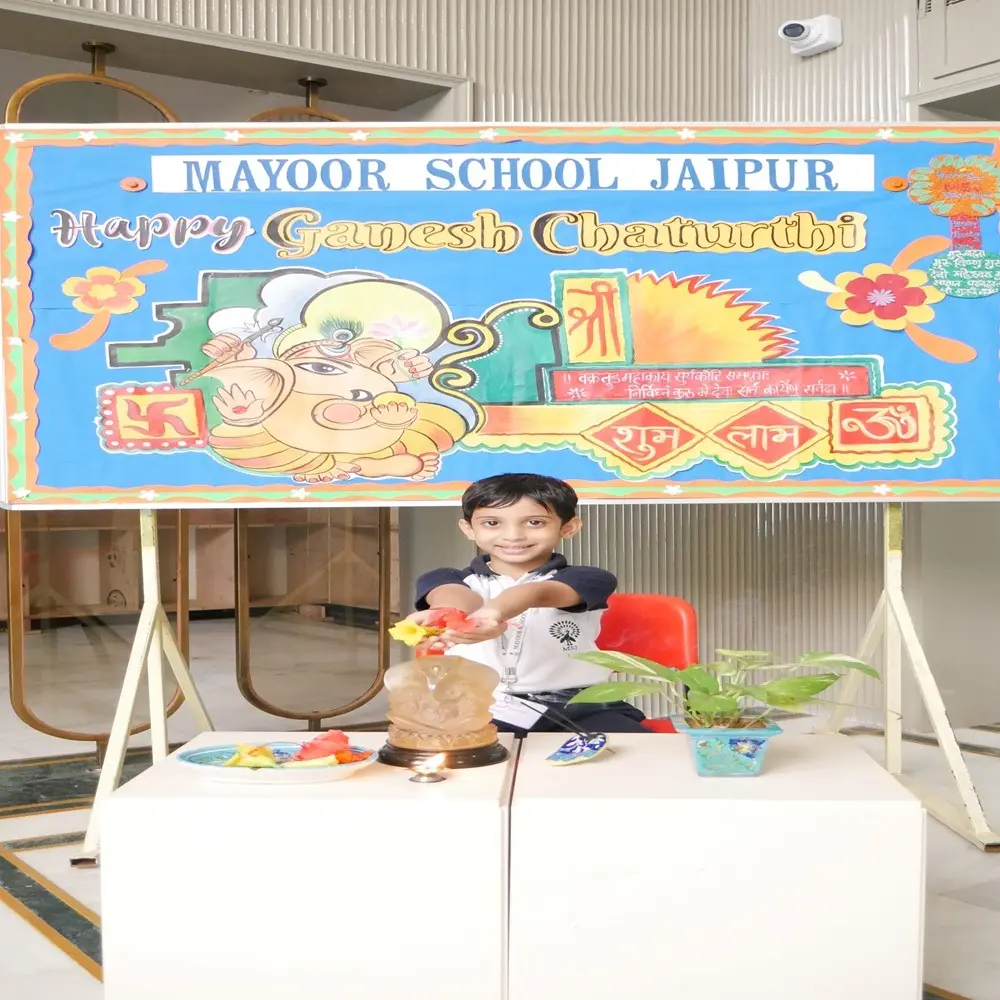
Ganesh Chaturthi, also known as Vinayaka Chaturthi, is one of the most significant Hindu festivals celebrated across India, especially in Maharashtra. It marks the birth of Lord Ganesha, the god of wisdom, prosperity, and good fortune. The festival spans 10 days, starting on the fourth day of the Hindu lunar month of Bhadrapada (Shukla Paksha Chaturthi) and ending on the 14th day (Anant Chaturdashi).
But have you ever wondered why Ganesh Chaturthi is celebrated for 10 days? Let’s explore!
According to Hindu mythology, Lord Ganesha was created by Goddess Parvati using sandalwood paste. He was brought to life to guard her door while she bathed. When Lord Shiva, Parvati's husband, returned, he was denied entry by Ganesha, unaware of Shiva’s identity. In anger, Lord Shiva beheaded Ganesha. Upon realizing the truth, Lord Shiva promised to bring him back to life and placed an elephant’s head on his body, thus reviving him. From that day onwards, Ganesha is worshiped as the remover of obstacles and the harbinger of new beginnings.
The 10-day celebration of Ganesh Chaturthi holds profound cultural and spiritual meaning. Here are some reasons why it lasts for 10 days:
Lord Ganesha, with his unique form and attributes, teaches us many valuable life lessons. Here are some important learnings:
For families celebrating at home for the first time, ten days can feel like one long stretch of rituals. In practice, each phase of the festival has its own mood and purpose, moving from welcome to worship to a warm farewell.
Understanding this sequence helps children see the festival as a complete story with a beginning, a middle, and a graceful ending, rather than a random set of rituals.
Ganesh Chaturthi was observed largely within homes for centuries. Its transformation into a large public celebration is usually traced to the late nineteenth century in Pune, when freedom fighter Lokmanya Bal Gangadhar Tilak encouraged community pandals and public Ganeshotsav as a way to bring people together across caste and class lines during the freedom movement.
That shift explains why the festival still carries such a strong sense of collective ownership. The idol may sit in one home, but the celebration belongs to the whole street.
In Rajasthan, the festival has its own local colour. Jaipur’s Moti Dungri Ganesh Temple draws long queues of devotees, and neighbourhood pandals across the Pink City fill with decorations, bhajans and volunteer-run food stalls. For families new to the city, joining a local pandal is one of the simplest ways to feel at home. Parents searching for the best school in Jaipur often look for exactly this balance: an institution where academic rigour sits alongside cultural rootedness, and where children experience devotion, community service and civic pride first-hand.
Festivals are one of the richest teaching tools available to a school. When students prepare eco-friendly clay idols, write short scripts on Ganesha’s stories, design rangoli, or calculate the material cost of a pandal, they are practising art, language, mathematics and civic awareness at the same time. This is exactly why Activity-Based Learning works so well in the early and middle years: the concept is not memorised from a page, it is built with the hands, discussed with friends and remembered for years.
Festival-linked projects also build softer, harder-to-teach skills. Children learn to work in teams, respect different family traditions, present their work to an audience and take responsibility for cleaning up afterwards. A ten-day festival gives them a natural window to plan, execute and reflect.
The scale of the festival brings a real environmental responsibility with it, and this is a conversation worth having with children rather than around them. Here are ten easy steps any family can follow:
Here is a simple family challenge that turns devotion into daily practice. Assign one small habit to each of the ten days and let children tick them off. It is the same principle behind the 20+ enrichment programs that help students build discipline through short, repeatable actions rather than one-off effort.
|
Day |
Habit to practise |
|
Day 1 |
Begin the day with gratitude-name three things you are thankful for. |
|
Day 2 |
Listen fully before replying, just once, to someone at home. |
|
Day 3 |
Read for twenty minutes without a screen nearby. |
|
Day 4 |
Help a family member with a chore without being asked. |
|
Day 5 |
Learn one new word, fact, or skill and teach it to someone. |
|
Day 6 |
Share food, stationery, or a toy with someone who needs it. |
|
Day 7 |
Finish one task you have been postponing. |
|
Day 8 |
Spend an hour outdoors, away from devices. |
|
Day 9 |
Apologise or say thank you to someone you have been meaning to. |
|
Day 10 |
Write down one obstacle you want to let go of, along with the idol. |
Children absorb far more from what they see than from what they are told. If they watch the family choose a clay idol, distribute prasad to neighbours and clean the space afterwards, those values settle in quietly. Our campus celebrations follow the same idea, and parents can see these moments through the Mayoor School Jaipur Photo Gallery, where festival assemblies, art displays, and student performances are documented throughout the year.
Ganesh Chaturthi, seen this way, is not only a religious observance. It is ten days of practice in patience, generosity, responsibility and letting go lessons that stay long after the idol has been immersed.
Ganesh Chaturthi is more than just a festival; it’s a journey of devotion, learning, and community. The 10 days remind us of the importance of spiritual growth, while Lord Ganesha’s teachings inspire us to live a life filled with wisdom, patience, and perseverance. As we celebrate this beautiful festival, let’s remember the values and lessons that Lord Ganesha embodies and strive to incorporate them into our lives.
Happy Ganesh Chaturthi! From the leading CBSE School in Jaipur, Mayoor School Jaipur.
The ten days represent the period Lord Ganesha is believed to stay with his devotees on Earth. The festival begins on Bhadrapada Shukla Chaturthi and concludes on Anant Chaturdashi with Visarjan, symbolising the natural cycle of arrival, presence and departure.
It begins on the fourth day (Chaturthi) of the Shukla Paksha in the Hindu lunar month of Bhadrapada and ends on the fourteenth day, Anant Chaturdashi. In the Gregorian calendar, this usually falls between late August and mid-September, and the exact dates change every year, so check a current panchang.
Anant Chaturdashi is the concluding day, when the idol is taken in a procession and immersed in water. The immersion, or Visarjan, is a reminder that everything formed from the elements eventually returns to them, and that attachment must give way to acceptance.
Yes. Many families observe the festival for one and a half, three, five or seven days depending on family tradition, space and convenience. The rituals remain the same; only the duration before Visarjan changes. There is no obligation to keep the idol for the full ten days.
The modak is traditionally described as Lord Ganesha’s favourite sweet. Its sweet filling inside a plain outer covering is often explained to children as a symbol of knowledge: the reward lies inside, and you have to work through the surface to reach it.
Use a natural clay idol with water-based colours, keep decorations free of thermocol and plastic, immerse the idol at home in a bucket or drum, reuse the settled water for plants, and compost the flowers. Letting children handle the clean-up turns the festival into a lasting lesson in responsibility.
Beyond the mythology, the festival teaches practical values: patience, careful listening, humility, respect for elders, teamwork through community celebration, and environmental responsibility through eco-friendly practices. These are the same qualities schools work on daily through projects, clubs, and classroom activities.
Copyright ©2026 held by Global Institute of Technology Society and Mayoor School Jaipur | This template is made with by Shopivana
