Admission Enquiry 
Admission Enquiry
Most parents wait until Class 10 or 12 before seriously considering their child's future. But here is something worth reflecting on: by the time a student reaches the board exam stage, the window for genuinely guided exploration has already narrowed. Career counselling for students is not a last-minute rescue tool; it is a long-term investment that pays its richest dividends when it begins early. In fact, understanding time management tips for school students goes hand-in-hand with career planning, because both habits, managing time and thinking ahead, are best formed well before the pressure of high school sets in.
So why Class 6? Because that is precisely when children begin forming identity, discovering interests, and asking: “What am I actually good at?” Ignoring these signals, or worse, dismissing them as too early, can leave students feeling lost exactly when they need direction the most.
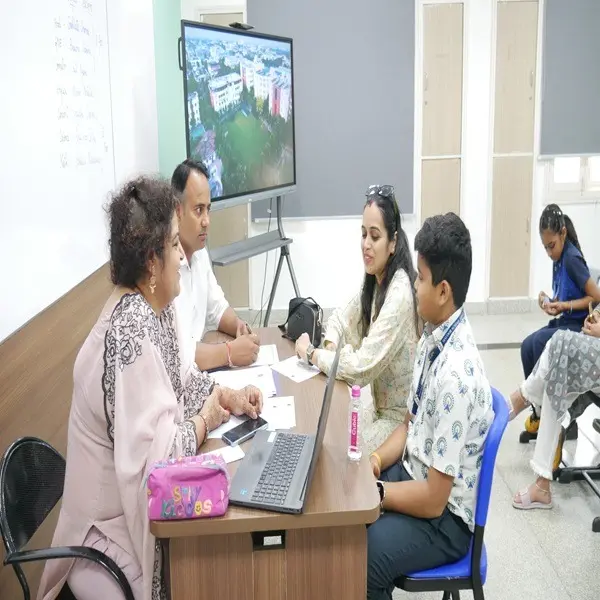
Career guidance and counselling for students is often misunderstood as a process of matching marks to professions. In reality, it is a structured, empathetic dialogue between a trained counsellor and a student, one that uncovers strengths, interests, learning styles, and values, and uses all of that to map possible futures.
A good counsellor does not just say, “You scored well in science, so become a doctor.” They ask deeper questions: Do you like working with people or ideas? Do you prefer structured problems or open-ended creativity? Are you energised by competition or collaboration? These conversations, when held early enough, help students make choices from a place of self-awareness rather than societal pressure.
Understanding why career counselling is important for students requires looking beyond academics. Schools teach subjects, but they rarely teach children how to think about their own futures. Career counselling fills that gap by doing three essential things:
When students have been gradually exploring career options since middle school, the Class 10 or 12 crossroads feels manageable rather than overwhelming. They already have a sense of direction. Students who have not received this guidance often feel paralysed. They pick streams based on peer pressure or parental expectations, not on a genuine fit.
A student who understands why they are studying something is far more motivated than one who is just chasing marks. Career awareness gives academic effort a purpose. When a child knows that their love for biology could lead to environmental science, marine research, or medicine, studying becomes meaningful, not mechanical.
One of the most common complaints from students is “When will I ever use this?” Career counselling answers that question. It bridges the gap between classroom learning and real-world application, making education feel relevant and alive.
Class 6 is a unique developmental window. Children at this stage are curious, open to new ideas, and not yet locked into fixed self-images. They have not decided that “I am a science person” or “I am bad at maths.” This fluidity is actually a gift, and career counsellors can use it beautifully.
Early career guidance and counselling for students in middle school typically focuses on:
This is very different from the high-stakes, stream-selection counselling of Class 10. And that is exactly the point. By the time stream selection arrives, a student who began their journey in Class 6 has had four years of self-reflection and exploration. They are ready.
Parents cannot do this alone, and they should not have to. The school environment is where children spend most of their waking hours, which means schools are uniquely positioned to support career awareness from an early age.
The best institutions do not just deliver academic content; they embed career awareness into the school culture. This includes guest speaker programmes, career fairs, personality assessments, and one-on-one counselling sessions. This is one reason why parents searching for the best school in Jaipur with fee structure often look specifically for institutions with robust student support programmes built into their framework.
There is a deeply underappreciated connection between academic pressure and a lack of direction. Many students who struggle with exam anxiety or low motivation are not academically weak; they simply do not know why they are working so hard. When a child has a sense of purpose, even a tentative one, the entire relationship with studying changes.
Schools and parents who want to genuinely reduce exam stress in children should consider career counselling as part of the solution, not just pressure reduction techniques. When students feel seen, heard, and guided, their anxiety naturally decreases because the future feels less like a fog and more like a road with signposts.
Parents are co-pilots in this journey, not navigators. The most helpful parents are those who listen more than they prescribe. Career counsellors often report that students feel most constrained not by their own limitations, but by the fear of disappointing their families.
Here is what supportive career-aware parenting looks like in practice:
Not all schools offer the same level of guidance infrastructure. If you are a parent evaluating options, it is worth asking: Does this school have a dedicated career counsellor? Are there structured programmes for students from middle school onwards? Do teachers actively connect subject matter to real-world applications?
Families considering a CBSE school in Jaipur should specifically look for institutions where career awareness is woven into the academic calendar, not offered as a one-time seminar in Class 10. The best schools treat it as a continuous conversation, not a crisis intervention.
Understanding how school support programs help students thrive academically and personally is a key factor. Schools with mentorship, counselling, and guided goal-setting tend to produce students who enter higher education with clarity and confidence, two qualities that matter far more in the long run than raw scores alone.
The world your child will work in looks very different from the one you grew up in. Artificial intelligence, green energy, space technology, digital health, and creative economy roles are reshaping what “good careers” look like. Many of the most in-demand jobs a decade from now have not been named yet.
This is precisely why early career guidance and counselling for students matters more than ever. A counsellor who stays current with industry trends can open children’s eyes to possibilities their parents’ generation never had and help them build the right foundation of skills and curiosity to pursue those paths with confidence.
Schools that understand how to motivate students in the classroom by connecting lessons to future possibilities are already doing a form of career counselling, one that is embedded in everyday learning rather than reserved for a single counselling session.
Career counselling for students is not a luxury for the academically anxious or a service reserved for Class 12 students staring down entrance exams. It is a foundational support system that, when introduced in Class 6, gives children the greatest possible advantage: time. Time to explore, to discover, to course-correct, and to grow into the version of themselves best suited for a meaningful career.
The schools that understand this and integrate career guidance into their DNA rather than treating it as an add-on are the ones producing graduates who do not just get jobs, but find real purpose. And the parents who champion this approach by choosing the best schools in Jaipur with strong counselling support are giving their children something no textbook can: a sense of direction.
Career counselling can meaningfully begin as early as Class 6 (around age 11–12). At this stage, counsellors focus on interest and aptitude exploration rather than specific career decisions. Starting early gives students years to self-reflect and explore before the high-pressure stream selection in Class 10.
Yes. Academic counselling focuses on improving study habits and grades. Career guidance and counselling for students is broader; it explores personality, strengths, interests, values, and long-term goals to help students understand what kind of work and life they are suited for. Both are valuable but serve different purposes.
When students have a sense of purpose, knowing why they are studying, their relationship with exams changes. Career counselling provides that sense of direction, which naturally reduces anxiety. Students exploring a path they care about tend to be more motivated and less overwhelmed by academic pressure.
Look for schools with a dedicated, qualified career counsellor on staff, regular career awareness activities from middle school onwards, individual counselling sessions, and a curriculum that connects academic learning to real-world applications. Schools that embed counselling into their culture rather than offering it only at crisis points are most effective.
Absolutely. One of the most valuable functions of early career counselling is uncovering strengths that standard academics do not measure, such as creativity, leadership, empathy, spatial reasoning, entrepreneurial thinking, and more. Counsellors use structured assessments and conversations to surface these qualities and connect them to real career pathways.
Not at all. Career counselling is equally valuable, often more so, for high-achieving students who feel pressure to pursue conventional “top” careers. Even strong students benefit from understanding their interests and values so they make genuinely fulfilling choices, not just academically impressive ones.
CBSE schools are encouraged to have counsellors and support staff as per CBSE guidelines. However, the depth and quality varies significantly between institutions. The best CBSE schools in Jaipur go beyond the minimum requirement, offering structured career programmes, aptitude testing, and mentorship that begins in middle school and continues through Class 12.

Copyright ©2026 held by Global Institute of Technology Society and Mayoor School Jaipur | This template is made with by Shopivana
