Admission Enquiry 
Admission Enquiry

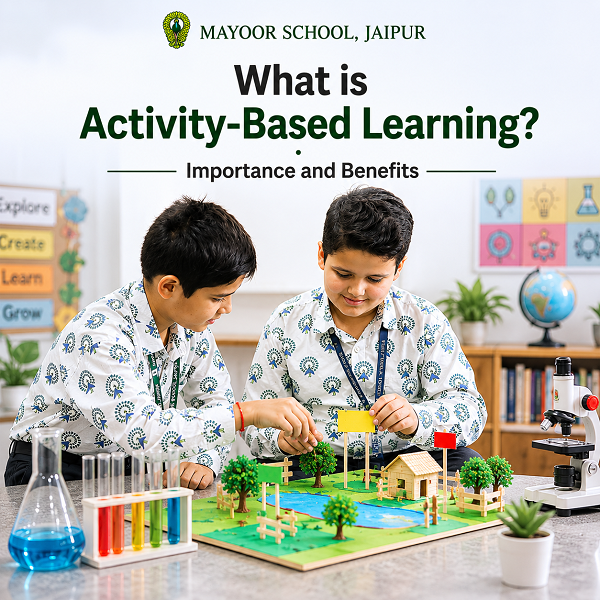
Discover what Activity-Based Learning is, why it matters in modern classrooms, real activity-based learning examples, and the long-term benefits it offers your child.
Imagine a classroom where children are not sitting silently with their eyes glued to a textbook, but instead they are building models, solving puzzles, performing skits, conducting small experiments, and laughing while they learn. That is the heart of Activity-Based Learning. It is a teaching approach where students learn by doing, not by simply listening. Instead of passively receiving information, learners participate in tasks that make concepts come alive in their minds.
In today’s rapidly changing world, where curiosity, creativity, and problem-solving skills matter more than rote memorization, Activity-Based Learning has emerged as one of the most effective methods to shape young learners. In this blog, we will explore what Activity-Based Learning truly means, why it is so important, what its benefits are, and look at some practical Activity-Based Learning examples that parents and teachers can use right away.
Activity-Based Learning is a student-centred teaching method in which children learn concepts through hands-on activities, group work, exploration, play, and real-life problem-solving. Rather than the teacher being the only source of knowledge, the child becomes an active participant in the learning process.
This approach is built on a simple but powerful idea: children remember what they do far better than what they only hear. When a child measures water to understand fractions, role-plays a historical figure, or builds a tiny bridge using ice-cream sticks to understand balance, the concept stays with them for life.
Activity-Based Learning blends naturally with modern pedagogical frameworks. For example, schools that follow STEAM Education, combining Science, Technology, Engineering, Arts and Mathematics, rely heavily on activity-driven classrooms because the subjects cannot truly be understood without doing.
The importance of Activity-Based Learning lies in how children’s brains are naturally wired. Young learners learn through their senses, by touching, seeing, hearing, moving, and experimenting. When a child engages multiple senses at once, the brain forms stronger neural connections, leading to deeper understanding and long-term retention.
Traditional rote learning, where children memorize answers without truly understanding them, often leads to short-term recall but limited real-world application. Activity-Based Learning, on the other hand, develops thinking skills, encourages curiosity, and prepares children to apply knowledge in everyday situations.
Here is why it has become a central part of modern education:
It makes learning meaningful: Children connect classroom concepts to the real world.
It builds confidence: Active participation reduces fear of mistakes and encourages exploration.
It supports diverse learners: Visual, auditory, and kinaesthetic learners all benefit.
It develops 21st-century skills: Critical thinking, communication, collaboration, and creativity grow naturally.
It increases engagement: Children are far more focused when they are doing something meaningful.
Beyond pedagogy, the physical environment also plays a huge role. School Infrastructure Impacts Child Development in powerful ways. Well-designed activity rooms, outdoor spaces, libraries and laboratories give children the room to explore freely and turn lessons into experiences.
Activity-Based Learning is more than just adding a few fun games to a lesson. It follows a thoughtful structure that ensures children grow academically, emotionally and socially. Some of its key features include:
Learner-centred approach: The child is at the centre of every activity, while the teacher acts as a facilitator and guide.
Hands-on engagement: Children handle materials, conduct experiments, and create things instead of just observing.
Collaborative learning: Group activities encourage teamwork, empathy, and communication.
Real-life relevance: Lessons are tied to everyday situations, making knowledge practical.
Progressive difficulty: Activities are designed to grow with the child’s age and ability.
Teachers planning these experiences also need clarity on structure. Understanding the difference between a lesson plan and a unit planhelps educators design activities that fit both daily learning goals and the bigger picture of a unit or theme, ensuring that each hands-on task connects back to a clear learning outcome.
One of the most common questions parents ask is, “What do activity-based learning examples actually look like in a real classroom or at home?” The good news is that activity-based learning can be adapted for every age, from toddlers to teens. Here are some practical examples you can relate to.
At the foundational stage, learning happens almost entirely through play. Sorting coloured blocks, finger painting, identifying animals through flashcards, singing rhymes with actions, and story-time with puppets are all powerful learning activities. Strong Early Preschool Programs use such play-based methods to build language, motor skills, and social behaviour in young children.
Primary students enjoy activities such as making fruit salad to learn about healthy eating, creating a paper map of their neighbourhood, growing a small plant to study life cycles, or staging a short play to understand a moral story. Math becomes fun when children use beads, currency notes (toy money), or measuring cups instead of just numbers in a notebook.
Older students benefit from project-based activities, building a working model of a windmill, conducting a survey on water usage in their neighbourhood, creating a short documentary on local history, debating current affairs, or designing posters on environmental issues. These tasks blend research, creativity, and presentation skills.
Modern classrooms also use technology to power activity-based learning. Interactive quizzes, virtual science labs, educational games, and collaborative online boards are all examples. In fact, thebenefits of smart boards in the classroom include making lessons interactive, helping children visualize complex topics, and allowing teachers to combine videos, drawings, and live tasks in one place.
Activity-Based Learning does not stop at the school gate. Parents can extend it at home through cooking together (great for measurement and chemistry), gardening, board games, DIY craft projects, or simple science experiments using kitchen ingredients. Engaging children in structured Winter Break Learning Activities, such as story journals, family quiz nights, or small home science experiments, keeps their minds active even during holidays.
When activity-based learning is implemented well, the benefits go far beyond academics. Children grow into confident, curious, well-rounded individuals. Below are some of the most powerful long-term benefits.
Children remember concepts much longer when they have experienced them physically. A child who has actually planted a seed and watched it grow understands photosynthesis differently from one who has only read about it.
Activities encourage children to ask questions, test ideas, make mistakes, and find solutions. This builds problem-solving skills that serve them throughout life.
When children are given the freedom to design, build, draw, or perform, their imagination flourishes. They learn that there can be more than one correct way to approach a problem.
Group activities teach children how to communicate, listen, negotiate, share, lead, and follow. These social and emotional skills are essential for personal happiness and professional success.
Every completed activity, no matter how small, gives a child a sense of achievement. Over time, this builds self-esteem and the courage to take initiative.
Children who are actively involved in their learning rarely feel bored. The classroom becomes a place they look forward to, not one they want to escape from.
Activity-Based Learning works best when combined with a wider range of co-curricular opportunities. Schools that offer 20+ enrichment programs such as robotics, music, sports, public speaking, dance, and art give children countless chances to discover their interests and strengths through doing.
In an activity-based classroom, the role of a teacher changes beautifully. Instead of being the only voice in the room, the teacher becomes a guide, a mentor, and a designer of experiences. Good teachers carefully plan activities that match the curriculum, encourage every child to participate, observe individual progress, and provide gentle support when needed.
Teachers also use a variety of modern resources to make planning more efficient and creative. Free AI Tools for Studentsand educators, like quiz generators, lesson planners, and idea-suggestion tools, can help teachers design more engaging activities and provide personalized practice material for different learning levels.
Parents are equally important partners in this journey. Activity-Based Learning works best when home and school move in the same direction. Parents can support it by:
Encouraging questions and curiosity rather than only asking about marks.
Providing safe spaces and basic materials for crafts, experiments and reading.
Limiting passive screen time and replacing it with creative activities.
Celebrating effort, not just results.
Talking to teachers regularly to understand what is being taught and how to extend it at home.
When parents and teachers join hands, learning becomes a joyful and continuous process rather than a stressful classroom-only activity.
Not every school that mentions “activity-based learning” on its website truly practices it. As a parent, you need to look beyond brochures and observe how learning actually happens. Here are some signs of a school that genuinely follows this approach:
Classrooms have flexible seating and learning corners, not just rows of desks.
Children regularly work on projects, presentations, and hands-on tasks.
Teachers are trained in modern pedagogy and use a mix of methods.
The school has well-equipped labs, libraries, art rooms, and outdoor spaces.
Assessments include practical work, observations, and creativity, not only written tests.
When you are searching for the best school for admissions, visit the campus, talk to current parents, and observe a few classes if possible. A school that truly values activity-based learning will be proud to show it in action.
If you are based in Rajasthan and exploring options, you will find that the Best CBSE School in Jaipur typically blends a strong academic curriculum with rich, activity-driven classrooms, sports, arts and life-skill programs preparing children for both board exams and the real world.
Of course, every family also needs clarity on cost and value. Looking up the Best school in Jaipur with a fee structurecomparison can help you understand what facilities, programs, and learning experiences are included in the fee, so you can make an informed decision that fits both your child’s needs and your budget.
As the world becomes more dynamic, the skills children need are changing fast. Employers and universities are no longer impressed only by marks; they look for creativity, collaboration, adaptability, and the ability to learn continuously. Activity-Based Learning naturally builds all of these qualities.
It also aligns beautifully with the goals of the National Education Policy in India, which emphasizes experiential learning, competency-based education, and reducing the burden of rote memorization. Schools that have already embraced activity-based methods are simply ahead of the curve, preparing children not just for the next exam, but for the next decade of their lives.
Activity-Based Learning is not a trend; it is a return to the most natural way human beings learn, by doing, exploring, and experiencing. It nurtures curiosity, builds confidence, develops critical thinking, and turns classrooms into joyful spaces where children actually want to be.
From simple activity-based learning examples like sorting blocks and growing plants, to advanced project-based work in higher classes, the impact of this approach is visible in how children think, behave and grow. As a parent or educator, choosing or supporting a school that genuinely follows this method is one of the best gifts you can offer to a child.
Because in the end, the goal of education is not just to fill young minds with information, but to help them discover, question, create, and contribute. And that journey begins the moment a child stops just listening and starts doing.
Here are some of the most common questions parents and teachers ask about Activity-Based Learning, answered in a simple and clear way.
Activity-Based Learning is a teaching method in which children learn concepts by doing activities instead of just listening or memorizing. Through play, experiments, group tasks, projects and real-life examples, students actively participate in their own learning, which makes understanding deeper and remembering easier.
Common activity-based learning examples include sorting colored blocks, role-playing historical events, growing a plant to study life cycles, building model bridges, conducting simple science experiments, creating posters, solving math problems using real objects, and group projects on topics like environment, health or community helpers.
Activity-Based Learning is important because it makes learning meaningful, improves memory, builds confidence, and develops critical thinking. Children understand concepts more deeply when they experience them through their senses. It also nurtures creativity, communication and problem-solving skills, which are essential for academic success and real-life situations.
The main benefits of Activity-Based Learning include better understanding and retention of concepts, stronger critical thinking, improved creativity, better social and emotional skills, higher confidence, increased focus, and reduced boredom. It also supports holistic development by combining academics with creativity, collaboration and real-world problem-solving.
Traditional learning is teacher-centred and depends mainly on lectures, textbooks and memorization. Activity-Based Learning is student-centred, where children learn by doing activities, experiments and projects. Instead of passively receiving information, students actively explore, question and create, leading to deeper understanding and stronger long-term skills.
Activity-Based Learning is suitable for every age group, from preschool to higher classes. Younger children learn through play, songs and sensory activities, while older students benefit from projects, experiments, debates and research-based tasks. The activities simply become more complex as the child grows in age and ability.
Parents can support Activity-Based Learning at home by encouraging questions, providing basic craft and reading materials, doing simple kitchen science experiments, gardening together, playing educational board games, and limiting passive screen time. Celebrating effort over marks and staying connected with teachers helps extend classroom learning into everyday life.

Copyright ©2026 held by Global Institute of Technology Society and Mayoor School Jaipur | This template is made with by Shopivana
